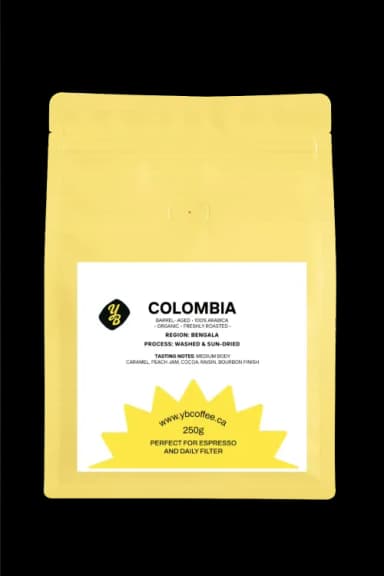
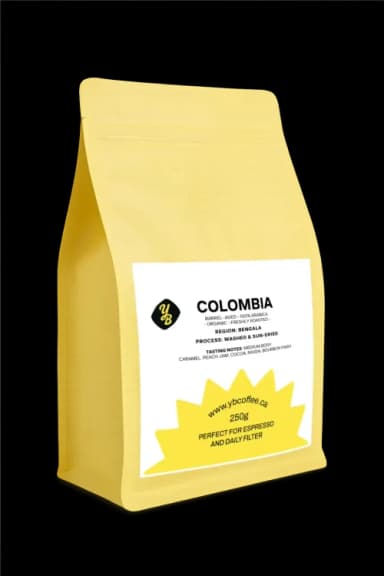
Colombia Bengala — Bourbon Barrel-Aged
Tasting notes: Chocolate, caramel, grapefruit + raisins, baked apple, smoky oak, winey esters, bourbon-inspired aromas
Profile: Medium body, bright acidity with complex barrel-derived notes
Product information
$CA 18
Origin: Bengala region, Colombia
Altitude: ~1600–2000 m
Variety: 100% Arabica (e.g., Castillo & Caturra)
Process: Washed & sun-dried
Roast: Fresh, medium roast optimized for Espresso & Filter
Colombia Bengala beans are cultivated high in the Andes of the Bengala region, at elevations between 1600-2000 meters, where mineral-rich volcanic soils, consistent diurnal temperature swings, and well-distributed rainfall promote slow, even cherry maturation. The varieties Castillo and Caturra contribute firmness of bean structure and clarity of flavour when processed.
After harvest, with standard washed processing followed by sun-drying, the green beans are introduced into fresh oak bourbon barrels previously used for ageing Kentucky bourbon. This is a post-harvest barrel-ageing technique: because green coffee has a highly porous and hygroscopic matrix, it is capable of absorbing (via adsorption and diffusion) volatile aromatic compounds from the oak wood staves and residual bourbon congeners.
During barrel ageing, careful control is applied over moisture content, relative humidity, and temperature to avoid spoilage or off-flavours. The beans typically spend several weeks in the barrel, gently agitated or turned to ensure even exposure to the wood.
After ageing, the beans are roasted with a profile that preserves the delicate aromatic compounds acquired in the barrel: achieving balance between origin acidity and barrel-derived flavours. Roast development emphasizes initial caramelisation and Maillard reaction without overemphasizing roast bitterness or smoke (to avoid masking the barrel aromas).
Important Notes:
No alcohol is added during the barrel ageing. The process does not involve soaking in spirits; rather, it relies entirely on volatile compounds already present in the barrel and wood.
The final roasted coffee contains no alcohol—all bourbon-derived notes are aromatic compounds transferred through the wood and bound within the bean during ageing.